Black and White Digital Paper: Timeless Versatility Meets Modern Creative Workflow
In an era defined by sensory overload—vibrant gradients, animated assets, and algorithmically saturated feeds—a quiet shift is unfolding across design studios, marketing departments, and independent creative practices: a renewed embrace of Black and White Digital Paper. Not as nostalgia, but as strategy. Not as limitation, but as precision. This isn’t about stripping color for austerity—it’s about harnessing contrast, clarity, and compositional control to build stronger visual hierarchies, more intentional brand expressions, and scalable design systems.
What Exactly Is Black and White Digital Paper?
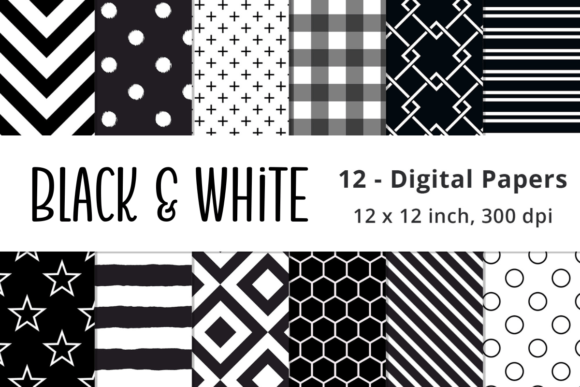
Black and White Digital Paper refers to high-resolution, raster-based patterned backgrounds designed specifically for digital use—typically at 12 x 12 inches and 300 dpi for print-ready fidelity. Unlike vector swatches or generative textures, these are flattened JPG files: self-contained, immediately deployable, and optimized for real-world application in tools like Adobe Photoshop, Affinity Designer, Canva Pro, and even modern web-based editors.
Crucially, they’re not monochrome filters applied to color patterns—they’re conceived in grayscale from the outset. Every line weight in the Black and White Chevron, every pixel-perfect repeat in the Black and White Gingham, and every tonal balance in the Black and White Honeycomb is calibrated for maximum legibility, texture integrity, and tonal harmony. Because they’re raster—not vector—they preserve subtle grain, ink-like halftones, and hand-drawn irregularities that vectors often flatten into clinical uniformity.
Why This Moment? Contextual Relevance in a Shifting Creative Landscape
The resurgence of Black and White Digital Paper aligns with three converging developments across professional creative practice:
- Brand Differentiation Through Restraint: As consumers grow fatigued by algorithm-driven visual noise, brands are turning to disciplined palettes—not as cost-saving measures, but as signals of confidence and coherence. A luxury stationery line using Black and White Polka Dots on its wedding invitations communicates intentionality; a fintech startup layering Black and White Stripes beneath data visualizations adds rhythm without distraction.
- Hybrid Workflows Demand Interoperability: Freelancers juggle Figma for UI mockups, Illustrator for logos, and Canva for client-facing social templates. Raster-based Black and White Digital Paper eliminates format friction—no need to convert SVGs, no worrying about missing fonts or linked assets. Drop a JPG into any layer-based editor, adjust opacity or blending mode, and move forward.
- Print-on-Demand Maturity: With platforms like Printful, Gelato, and local print partners now supporting direct JPG uploads at true 300 dpi, designers no longer sacrifice quality when moving from screen to physical product. That Black and White Stars pattern doesn’t just look crisp on a PDF—it translates flawlessly to letterpress business cards, foil-stamped notebooks, or textured greeting cards.
Practical Applications: Beyond “Just Backgrounds”
While often categorized under “scrapbooking supplies” or “digital paper bundles,” the 12 included Black and White Digital Papers function as modular design infrastructure—not decorative afterthoughts. Consider how professionals deploy them today:
- Marketing Assets: A B2B SaaS company uses Black and White Honeycomb as a subtle overlay behind testimonial quotes in LinkedIn carousels—adding depth without competing with text. The geometric repetition reinforces themes of structure and reliability.
- Product Packaging Mockups: Product photographers layer Black and White Gingham beneath flat-lay shots of artisanal goods. Its familiarity evokes craftsmanship and heritage—without requiring custom illustration.
- Editorial Design Systems: A quarterly newsletter for design educators uses Black and White Chevron as a section divider between long-form essays and case studies. Its directional energy guides the reader’s eye naturally downward—no additional UI elements needed.
- Client Presentations: Freelance strategists embed Black and White Stripes into slide backgrounds at 15% opacity. It provides just enough visual texture to prevent “flat screen fatigue” during 90-minute discovery sessions—while keeping focus squarely on content.
Understanding the Technical Nuance: Why “Not All Are Seamless” Is a Feature, Not a Flaw
A critical distinction sets this collection apart: Due to the different pattern types, not all digital papers are seamless and cannot be tiled. This isn’t a production oversight—it reflects thoughtful curation aligned with contemporary usage patterns.
Seamless tiling made sense in early web design (think CSS background-repeat) or mass-produced textile workflows. But today’s professionals rarely tile full-page patterns. Instead, they curate—selecting a single 12×12 frame as a deliberate compositional element. A non-seamless Black and White Stars pattern, for example, might feature organic star clustering in the upper third—perfect for anchoring a headline or logo. A hand-drawn Black and White Doodle variant (included in the set) intentionally avoids repetition to feel human-scaled and editorially authentic.
This approach supports what designers call “contextual appropriateness”—choosing a pattern whose scale, density, and rhythm serve the specific medium and message, rather than defaulting to infinite repetition. It also reduces cognitive load: viewers subconsciously register repetition as background noise. A singular, intentional frame becomes a design decision—not ambient filler.
Integration Into Real-World Workflows
Here’s how professionals actually use these 12 Black and White Digital Papers—not as static downloads, but as living components:
For Graphic Designers
They’re imported directly into Photoshop or Affinity Photo as smart objects. Designers apply layer masks to reveal only the portion interacting with typography—say, letting Black and White Polka Dots emerge beneath a drop cap while fading to white elsewhere. Blending modes like Multiply or Overlay let the underlying paper interact dynamically with type color and stroke weight.
For Marketers
Using Canva Pro’s Brand Kit, teams upload the JPGs as “brand elements.” When building social templates, they drag in Black and White Stripes once—and reuse it across dozens of variants. Because it’s a flattened raster file, there’s zero risk of font substitution or layout drift when shared across team members.
For Entrepreneurs & Small Studios
These papers accelerate client delivery. A wedding planner orders custom foil-stamped menus via a print partner, uploads the Black and White Chevron JPG directly to their portal, and receives press-ready proofs in under 48 hours—no back-and-forth over vector exports or bleed adjustments.
Looking Ahead: Simplicity as Strategic Infrastructure
The value of Black and White Digital Paper isn’t frozen in its current form—it lies in its adaptability to emerging needs. As AI-assisted design tools mature, prompt-based generation excels at novelty but struggles with consistent texture language across touchpoints. A curated set of 12 purpose-built papers provides exactly that consistency: a tactile vocabulary that scales from email headers to trade show banners.
It also anticipates growing demand for accessibility-first design. High-contrast black-and-white patterns inherently support WCAG 2.1 AA compliance when used with appropriate text contrast ratios—no additional contrast-checking plugins required. And because they’re raster-based at 300 dpi, they avoid the rendering inconsistencies that sometimes plague complex vector patterns across browsers and devices.
Ultimately, this collection represents more than a bundle of JPGs. It’s a response to a professional reality: creators don’t need more options—they need better-considered constraints. Constraints that clarify intent. That reduce decision fatigue. That ensure fidelity from concept to print. That speak with quiet authority in a world shouting for attention.
Whether you’re developing a brand identity system, producing limited-edition stationery, designing presentation decks for enterprise clients, or building digital products with tangible texture, these 12 Black and White Digital Papers offer immediate utility grounded in enduring design principles. They’re not retro. They’re resolved.