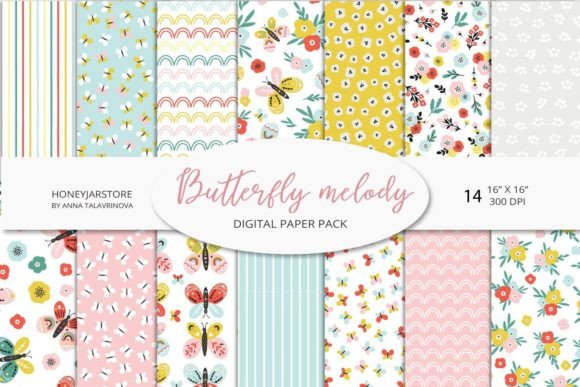
Butterfly Melody: A Seamless Pattern Pack That Moves With Your Creative Workflow
Butterfly Melody isn’t just another holiday-themed digital paper collection—it’s a precision-crafted, production-ready asset pack designed to integrate cleanly into real-world creative and business workflows. Whether you’re printing custom fabric for a boutique clothing line, designing wedding stationery for a client, or building planner inserts for your Etsy shop, Butterfly Melody delivers consistent quality, technical reliability, and stylistic cohesion without requiring post-processing gymnastics.
What Butterfly Melody Is—and What It Replaces in Your Process
At its core, Butterfly Melody is a boho Christmas seamless pattern pack containing 14 high-resolution, repeatable designs—each delivered as a 5000×5000 PNG at 300 DPI, plus vector-based AI and EPS files that preserve scalability and editing flexibility. Unlike generic clipart bundles or low-res downloads, this set was built with production constraints in mind: no visible seams, no pixelation at print scale, no embedded raster layers that break when resized.
That means Butterfly Melody replaces several time-consuming steps in your typical workflow: sourcing individual motifs, manually tiling patterns, adjusting color balance across multiple files, or re-exporting assets for different output formats. It eliminates the “last-minute export panic” when a client requests both a fabric swatch PDF and a web-optimized SVG version of the same design.
How It Fits Before, During, and After Key Project Phases
Before a project starts, Butterfly Melody serves as a reliable foundation—not inspiration, but infrastructure. When you’re scoping a custom textile order for a sustainable fashion brand, having pre-vetted, color-coordinated, seasonally appropriate patterns lets you move faster from mood board to mockup. You’re not hunting for “boho Christmas vector” on stock sites while juggling three other deadlines—you’re selecting from a curated, technically sound set that already meets your output specs.
During execution, the dual-format delivery (vector + high-res raster) means fewer format-switching bottlenecks. Use the EPS file to adjust repeat spacing or recolor globally in Illustrator for a fabric mill submission. Drop the PNGs directly into Canva, Affinity Designer, or Adobe InDesign for quick layout iterations—no resampling, no transparency issues, no mismatched DPI warnings. The consistency across files reduces QA time: if one pattern works at 300 DPI on a 24″×36″ poster, all 14 will.
After delivery, Butterfly Melody supports scalability and reuse. A wedding stationery designer can license the pack once and apply it across invitations, menus, envelope liners, and digital RSVP cards—all while maintaining visual continuity. A planner creator can rotate patterns across monthly layouts, habit trackers, and goal-setting pages without breaking rhythm or brand tone. There’s no need to re-purchase or re-license for each new product variant.
Integration With Tools, Platforms, and Teams
Butterfly Melody works where you already work. The EPS and AI files integrate natively with Adobe Creative Cloud—ideal for designers who manage layered brand assets or need precise spot-color control for screen printing. The PNGs are optimized for drag-and-drop use in non-professional tools like Cricut Design Space, Silhouette Studio, or even Google Slides for educator-created holiday classroom materials.
If you collaborate with printers, fabric mills, or freelance developers, Butterfly Melody simplifies handoffs. Instead of sending fragmented JPEGs with inconsistent naming or resolution, you deliver a single, clearly labeled folder with production-grade assets—and documentation is built into the filenames (e.g., ButterflyMelody_Pattern07_ForestBoho_Christmas.png). That level of organization cuts down on revision rounds and miscommunication.
For small business owners using platforms like Printful, Gelato, or Spoonflower, the 5000×5000 size aligns with common upload requirements for fabric, wallpaper, and greeting card templates. No cropping, no scaling guesswork—just upload and produce.
Practical Implementation Tips for Real Workflows
- Start with your output first. If you’re designing for fabric, open the EPS in Illustrator and test the repeat tile at actual scale (e.g., 12″×12″) before committing to color edits. Vector gives you control; raster gives you speed—choose based on stage, not habit.
- Batch-process color variants early. Use the AI file to create alternate palettes (e.g., muted sage + cream for eco-brands, deep plum + gold for luxury weddings). Save each as a named layer or artboard—then export only what you need for a given client.
- Organize by use case, not just file type. Create subfolders: /for-print (EPS + 300 DPI PNG), /for-web (resized 2000×2000 PNGs), /for-cutting-machines (SVG exports from the AI). This prevents accidental use of web-optimized files for print jobs.
- Test seamlessness before finalizing layouts. Place two copies of a PNG side-by-side in Photoshop or Figma and zoom to 200%. Look for subtle shifts in line weight or motif alignment—Butterfly Melody is engineered to pass this test, but verifying builds confidence when working under deadline pressure.
Long-Term Usability and Quality Control
Because Butterfly Melody uses vector-first construction, it ages well. As software updates or output standards evolve (e.g., new Pantone libraries, updated CMYK profiles), you retain full editability—no need to track down original source files or reverse-engineer raster patterns. The clean linework and balanced negative space also ensure legibility across scales: a delicate butterfly motif reads clearly on a 2″ planner sticker and a 48″ event backdrop.
Consistency isn’t just visual—it’s operational. All 14 patterns share the same base grid, motif density, and color depth. That means switching between them mid-project won’t disrupt rhythm or require recalibrating contrast settings. For educators building themed lesson plans or marketers launching seasonal campaigns, that predictability saves hours over a single quarter.
Who Benefits Most—and How They Use It Differently
A textile entrepreneur uses Butterfly Melody to prototype fabric collections before ordering minimum yardage—testing drape, scale, and color interaction on physical swatches with zero upfront print cost. A wedding planner licenses it once and embeds patterns into editable Canva templates they sell to clients, adding white-label value without design overhead. A productivity coach integrates the motifs into Notion dashboard headers and printable reflection sheets—subtly reinforcing seasonal intentionality without distracting visuals.
Even educators repurpose it thoughtfully: the botanical-meets-festive aesthetic supports winter science units (butterfly life cycles), cultural studies (global holiday symbolism), or art integration projects—without leaning on clichéd Santa graphics. The quality ensures crisp projection in classrooms and clean photocopying for handouts.
Final Consideration: Integration Over Isolation
Butterfly Melody doesn’t exist to be admired in isolation—it exists to move through your process. Its value multiplies when treated as infrastructure, not decoration. That means storing it in your asset library alongside brand fonts and logo variants, tagging it in your DAM with keywords like boho-christmas, seamless-textile, and wedding-stationery, and auditing its usage quarterly to identify which patterns drive the most reuse or client requests.
When your workflow depends on speed, consistency, and cross-platform reliability—especially during high-demand seasons—having a set like Butterfly Melody isn’t a luxury. It’s operational hygiene. It removes friction so you can focus on decisions that matter: how a pattern supports a brand story, how a color palette resonates with an audience, or how a tactile detail elevates a customer’s unboxing experience.