Paws Digital Papers: 20 Seamless Paw Patterns
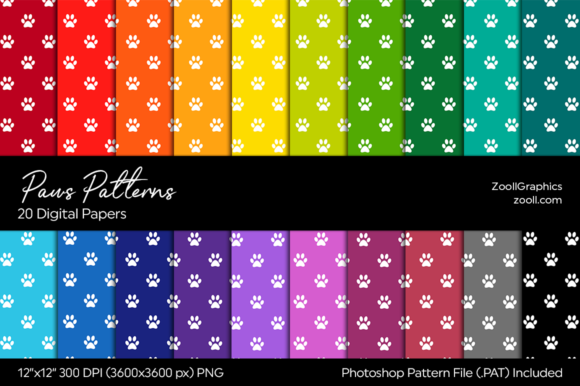
Whether you’re designing a birthday invite for your niece’s puppy-themed party, sprucing up a bullet journal with playful accents, or crafting branded packaging for a pet-friendly small business—Paws Digital Papers delivers immediate, professional-ready texture and charm. This curated collection isn’t just “cute.” It’s purpose-built: 20 seamless, tileable paw print patterns in thoughtfully chosen colors—red, orange, yellow, green, teal, turquoise, blue, purple, pink, grey, and black—with two color variations per hue (20 total). Each pattern scales cleanly, repeats invisibly, and works across physical and digital formats without pixelation or alignment hiccups.
Why Seamless Matters—Especially for Paws
Seamless tiling means no visible edges when the pattern repeats. That’s non-negotiable for planner stickers, gift wrap, or web backgrounds—where misaligned seams break immersion and undermine polish. These paw patterns were hand-tested and refined to ensure clean continuity at any scale. Unlike clipart-style paw graphics that require manual spacing or risk awkward gaps, Paws Digital Papers lets you fill a full 12×12 inch sheet—or a 4000-pixel banner—with confidence. At 300 dpi and 3600×3600 px, they’re print-ready for scrapbook paper, custom labels, fabric mockups, or even large-format wall decals.
Real Projects, Real Users
Here’s how different creators are already applying these patterns—no guesswork required:
- Scrapbookers use the grey and teal paws as subtle background layers beneath photos of pets or family adventures—adding warmth without competing for attention.
- Planner enthusiasts drop the soft pink or muted purple paw pattern into GoodNotes or Notability as a custom notebook cover, then layer transparent icons or handwritten headers on top.
- Small business owners (think: dog-walking services, pet boutiques, or vet clinics) apply the black or navy paw pattern to invoice templates, email footers, or social media story highlights—reinforcing brand identity with quiet consistency.
- Educators print the yellow or green paw tiles onto cardstock, cut them into flashcards or behavior charts, and laminate for classroom durability.
- Bloggers and content creators use the PAT file in Photoshop to quickly fill selection areas—like speech bubbles in Canva exports or newsletter banners—adding tactile personality in under 10 seconds.
Designing with Intention—Not Just Decoration
A paw print isn’t neutral—it carries tone. A bold red paw signals energy and playfulness; charcoal grey reads grounded and modern; soft mint green suggests calm care. When choosing a pattern, match the emotional subtext of your project. For example: a children’s literacy program might pair the bright orange paw with hand-drawn fonts and ample white space—keeping focus on the message, not the motif. Meanwhile, a boutique pet food label could use the deep teal paw as a subtle border element, letting ingredient photography take center stage.
Consistency matters more than variety. If you’re building a cohesive suite—say, invitations, thank-you cards, and favor tags—stick to one or two paw colors from the set. Use them across all pieces as unifying texture, not novelty. That builds recognition and feels intentional, not scattered.
Getting Started—Fast and Flexible
The ZIP includes two practical formats: 20 high-res PNGs (ideal for Canva, Silhouette Studio, Cricut Design Space, or Illustrator) and one .PAT file (for Photoshop users who want instant access via Edit > Fill > Pattern). No plugins, no conversions—just drag, drop, or select.
Need to recolor? Open any PNG in Photoshop or Affinity Photo, use Hue/Saturation or Selective Color adjustments, and save a new version. Because each pattern is flat (no shadows or gradients), edits stay crisp and predictable. Want transparency? All PNGs include alpha channels—perfect for overlaying on photos or textured backgrounds.
Adapting Across Platforms & Outputs
Digital-first creators benefit most from the PAT file—but don’t overlook the PNGs’ versatility. Upload them directly to:
- Canva: Set as page background, then add text boxes with 80% opacity for soft contrast.
- Cricut Design Space: Upload as Print Then Cut images for custom sticker sheets or iron-on transfers.
- Procreate: Import as a new layer, resize to fit your canvas, and use Clipping Masks to confine the pattern to shapes (e.g., a heart-shaped paw border).
- Web projects: Convert a PNG to CSS background-image with
background-repeat: repeat;—no JavaScript needed.
For print, always embed the image at 100% scale in your layout software (InDesign, Illustrator, or even Word with high-fidelity export enabled). Avoid resizing in low-res editors like basic photo apps—this preserves the 300 dpi integrity.
Making It Your Own—Without Losing Clarity
Originality doesn’t require reinventing the paw. It comes from thoughtful combination: pairing the turquoise pattern with a serif typeface for vintage-inspired stationery, or using the black paw as a subtle grid guide while sketching product packaging layouts. Try this quick exercise: pick one pattern, then limit yourself to two additional elements—e.g., one font + one accent color—and build three distinct mockups (a social post, a printable, and a physical item). You’ll see how much expressive range lives inside a single tile.
If you’re sharing work publicly—on Instagram, a portfolio site, or a client presentation—label usage clearly: “Background pattern from Paws Digital Papers.” It’s respectful, transparent, and aligns with creative community norms.
Who This Serves Best—And Why
This isn’t just for “crafty people.” It’s for the educator streamlining parent newsletters, the solopreneur designing her first Shopify banner, the marketer refreshing a shelter’s donation campaign visuals, or the freelance designer building a consistent asset library across client projects. What ties them together is a need for speed, reliability, and visual warmth—without sacrificing professionalism.
You don’t need advanced skills to use Paws Digital Papers. You do need clarity about your goal: Is it to delight? To organize? To communicate care? The patterns support those aims—they don’t define them. Let the paws anchor the texture. Let your voice, your audience, and your purpose drive the rest.