4th of July Patriotic Seamless Patterns: A Practical Guide for Designers and Crafters
The 4th of July marks the adoption of the Declaration of Independence in 1776—a foundational moment in U.S. history that continues to shape national identity, civic tradition, and creative expression. Unlike other holidays centered on seasonal change or religious observance, the 4th of July is uniquely tied to symbolism: stars, stripes, eagles, fireworks, and red-white-and-blue palettes carry layered historical resonance. This makes patriotic design more than decorative—it’s communicative. When selecting digital assets like seamless patterns for the 4th of July, understanding both context and technical fit helps avoid mismatched expectations.
What Sets 4th of July Patterns Apart from General Patriotic or Holiday-Themed Assets
Not all red, white, and blue designs serve the same purpose—or perform equally across applications. A 4th of July pattern must balance recognizability with versatility: it should signal Independence Day without leaning too heavily on clichés (e.g., cartoonish fireworks or oversized bald eagles) that limit reuse beyond a single season. It also needs structural integrity as a seamless repeat—meaning motifs align cleanly at tile edges, with no visible seams when tiled across fabric, packaging, or journal covers.
Compare this with generic “American flag” patterns: those often prioritize literal stripe-and-star geometry, which works well for banners or apparel but can overwhelm smaller surfaces like book spines or gift tags. In contrast, a thoughtfully curated 4th of July pattern set may include subtle interpretations—geometric star clusters, distressed bunting textures, abstract flame motifs, or watercolor-style stripes—that retain thematic clarity while supporting diverse scales and materials.
Format Considerations: Why Multiple File Types Matter
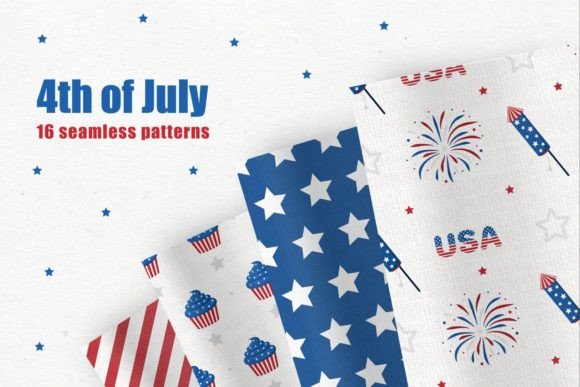
This particular 4th of July collection includes 16 patterns delivered in EPS10, PNG, JPG, and SVG. That range isn’t arbitrary—it reflects real-world production needs.
- EPS10 supports vector scalability and editing in Adobe Illustrator, making it ideal for adapting motifs to custom sizes or modifying colors for brand alignment—especially useful when preparing files for screen printing or embroidery digitizing.
- SVG offers lightweight, resolution-independent rendering for web use, interactive projects, or Cricut/Silhouette cutting machines—valuable if you’re designing digital invitations or cut files for paper crafts.
- PNG preserves transparency and high-fidelity raster detail, suitable for layered scrapbooking layouts, printable PDFs, or mockups where anti-aliased edges matter.
- JPG provides broad compatibility and smaller file sizes—practical for quick previews, email sharing, or platforms with strict upload limits, though it lacks transparency support.
Choosing one format over another depends less on preference and more on workflow stage and output medium. A designer prepping fabric for a small-batch clothing line would rely first on EPS or SVG; someone assembling a printable 4th of July planner might default to PNG for layering flexibility.
Use Cases and Realistic Application Limits
These patterns are optimized for physical and digital craft contexts—not mass-market branding or editorial publishing. Here’s how they hold up across common scenarios:
Scrapbooking & Paper Crafts
High-resolution PNGs work well for digital scrap kits or printed photo mats. Because the patterns are seamless, they scale smoothly across 12×12 inch layouts without distortion. However, extremely fine details (like tiny star outlines) may soften when printed on matte cardstock—test prints at actual size before committing to full batches.
Fabric & Textile Design
Vector-based EPS files allow precise color separation for dye-sublimation or rotary screen printing. The 16-pattern variety means you can coordinate background textures (e.g., a subtle gingham) with focal motifs (e.g., outlined liberty bells), giving cohesive collections depth. That said, these aren’t licensed commercial textile repeats—so if you plan large-scale retail production, verify repeat dimensions meet your printer’s tiling requirements.
Book and Journal Hardcovers
Wrapping paper–grade resolution translates reliably to hardcover laminates, especially when using SVG or EPS for crisp edge-to-edge coverage. One practical note: avoid patterns with strong directional elements (e.g., diagonal stripes) unless your case wrap tool allows rotation control—otherwise, alignment inconsistencies may appear along spine seams.
Packaging & Gift Wrap
The inclusion of scalable vector formats means you can adjust tile size to match standard box dimensions (e.g., 8×8 inch repeats for small gift boxes). But keep in mind that glossy or metallic finishes may mute subtle tonal variations—patterns relying on soft watercolor gradients may read flatter in foil-stamped execution than on-screen.
When This 4th of July Collection Fits—and When It Might Not
This set shines for creators who need dependable, production-ready assets without licensing ambiguity. It’s appropriate for small businesses producing limited-run goods, educators designing classroom materials, or hobbyists building themed planners or memory keepsakes. Its strength lies in breadth (16 distinct patterns) and format flexibility—not niche specialization like animated SVGs or Pantone-matched swatches.
It may fall short if you require:
- Commercial license extensions for resale of digital templates (e.g., selling editable Canva invitations using these patterns as base elements)—check the included license terms carefully;
- Photorealistic textures like woven burlap or crumpled crepe paper—these are stylized, graphic interpretations, not tactile simulations;
- Thematic expansion beyond Independence Day—there’s no overlap with Memorial Day, Veterans Day, or Flag Day motifs, so cross-holiday reuse is limited;
- Custom color variants—while vector files let you recolor manually, pre-built alternatives in navy-gold or pastel schemes aren’t included.
Making an Informed Choice Among 4th of July Resources
Evaluating 4th of July design assets isn’t just about counting patterns or checking file types—it’s about matching technical attributes to your intended output, timeline, and scale. Ask yourself:
- What’s the primary medium? (e.g., fabric vs. digital download)
- Do I need editable vectors, or will raster files suffice?
- How much time can I invest in manual adjustments versus needing plug-and-play readiness?
- Is consistency across multiple products important—or am I sourcing one-off pieces?
A set with 16 patterns gives room to experiment without over-relying on repetition. You could pair a bold starburst background with a muted stripe liner for a journal cover, then switch to a confetti-dot variant for coordinating gift tags—maintaining theme unity while avoiding visual fatigue. That kind of modularity is harder to achieve with single-pattern bundles or overly complex motif libraries where cohesion gets lost.
Also consider longevity. While some 4th of July graphics age quickly due to trend-driven styling (e.g., heavy grunge filters or exaggerated drop shadows), this collection leans into timeless structure: balanced spacing, clear negative space, and intentional motif density. That makes it more likely to remain usable beyond a single summer season—especially if stored with organized naming conventions and embedded metadata.
Ultimately, the right 4th of July resource supports your process—not complicates it. Whether you're hand-binding a commemorative notebook, prototyping a boutique candle label, or assembling a family scrapbook page, having adaptable, technically sound patterns saves time and preserves creative intent. And because the 4th of July carries weight beyond aesthetics, choosing assets that reflect both celebration and substance helps ground even the smallest project in something larger than itself.