Traditional Japanese Seamless Patterns
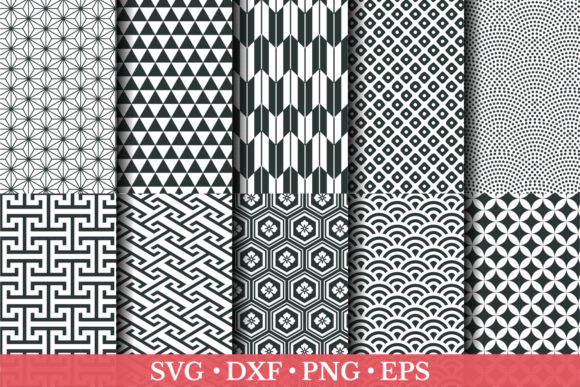
Traditional Japanese seamless patterns are more than decorative motifs—they’re visual languages rooted in centuries of craftsmanship, symbolism, and natural observation. Patterns like Asanoha (hemp leaf), Shibori (fold-and-resist dyeing geometry), Seigaiha (blue ocean waves), and Kikko (tortoiseshell) carry meaning: protection, resilience, continuity, or harmony. Unlike random repeats, these designs were developed to tile perfectly—edge to edge, corner to corner—making them ideal for textiles, wall coverings, packaging, and digital design.
Why This Bundle Fits Different Creators—Without Compromise
What makes a pattern bundle truly useful isn’t just the number of files—it’s how easily it adapts to your tools, timeline, and intent. This collection includes 10 distinct traditional Japanese motifs, each delivered in four essential formats: SVG, DXF, EPS, and PNG. That means no last-minute format conversions, no lost transparency, and no guesswork about compatibility.
For Beginners Learning Design Software
If you’re just starting with Cricut Design Space or Silhouette Studio, SVG and DXF files lower the barrier. You can drag and drop an Yagasuri (arrow feather) pattern into your project, resize it without pixelation, and cut it cleanly on vinyl or fabric. The included PNGs (13×13 inches, 300 dpi, transparent background) let you test layouts in Canva or PowerPoint before committing to physical materials. No design theory required—just choose a pattern that feels right, then apply it.
For Educators and Students
Teachers using these patterns in art, history, or cultural studies classes gain ready-to-use visuals that spark discussion. A Shippou (seven treasures) motif illustrates interlocking circles—a metaphor for cooperation and shared strength. An Asanoha pattern introduces symmetry, tessellation, and botanical symbolism across Edo-period Japan. Because all files retain vector precision, students can zoom into anchor points or isolate individual elements for analysis—no blurry screenshots or cropped images needed.
For Small Business Owners and Marketers
When branding a tea shop, wellness studio, or boutique stationery line, authenticity matters—but so does speed. These SVG and EPS files integrate directly into Adobe Illustrator or InDesign, letting you build cohesive packaging, social banners, or email headers in minutes. A Komon (fine repeat) pattern works as a subtle background for business cards; Seigaiha adds motion and calm to a meditation app landing page. And because every PNG is print-ready at 300 dpi, you avoid costly reformatting when ordering labels or fabric tags.
For Crafters and Hobbyists
Whether embroidering a furoshiki cloth or laser-cutting a wooden coaster set, precision matters. DXF files load natively into Silhouette Studio’s free version—no subscription required. SVGs work in ScanNCut and Cricut machines without flattening layers or losing stroke definitions. That means your Shibori-inspired cut file preserves crisp lines and intentional negative space, exactly as intended. Even if you’re hand-drawing stencils, the high-res PNGs serve as reliable references under tracing paper or lightboxes.
What’s Inside—and Why Format Variety Matters
You’ll receive one ZIP archive containing:
- 10 SVG files — Optimized for Cricut Explore, Silhouette Designer Edition, Adobe Suite, Inkscape, CorelDRAW, and ScanNCut. Scalable, editable, and layer-friendly.
- 10 DXF files — Compatible with Silhouette Studio’s free version, making complex repeats accessible without upgrading software.
- 10 EPS files — Ideal for professional print workflows in Illustrator or Make the Cut, preserving vectors and color fidelity.
- 10 PNG files — Transparent-background, 13×13 inches, 300 dpi—ready for mockups, presentations, or web use where vectors aren’t supported.
This isn’t over-delivery for its own sake. It’s responsiveness to real-world constraints: not everyone uses the same software, has the same budget, or works toward the same outcome. A freelance designer might rely on EPS for client handoff; a teacher might need PNGs for Google Slides; a maker might live in DXF world. Having all four formats means you’re never blocked by file type.
How Quality Shows Up—Beyond Resolution
“High quality” in pattern design isn’t just about pixels per inch. It’s about intentional spacing, balanced negative space, and authentic proportion. Each pattern here was built from historical references—not AI-generated approximations. The Seigaiha wave repeats with rhythmic consistency, not jittery distortion. The Kikko hexagons align cleanly across tiles, avoiding visible seams or misaligned vertices. That reliability saves time during production—whether you’re printing yardage or generating a website background that must scale across mobile and desktop.
It also supports creative flexibility. Because these are true seamless repeats—not cropped sections—you can adjust tile size, rotate motifs, or overlay multiple patterns (e.g., soft Shibori texture beneath bold Yagasuri) without breaking continuity. That kind of control matters whether you’re designing a limited-edition kimono or building a brand identity system that needs to feel both grounded and adaptable.
Who Might Look Elsewhere—and Why
This bundle focuses on traditional Japanese motifs—not modern interpretations, not anime-inspired graphics, and not generically “Asian” aesthetics. If your project calls for contemporary minimalism, calligraphic brushwork, or seasonal sakura illustrations, those aren’t included here. Likewise, it doesn’t contain editable color palettes or layered PSD files—so if your workflow depends heavily on raster-based color experimentation, you’d supplement with the PNGs rather than rely on them exclusively.
Also, while the patterns are culturally informed, they’re designed for practical reuse—not academic citation. Researchers needing provenance documentation, historical sourcing notes, or museum-grade attribution should pair this bundle with scholarly resources. But for creators who value respectful, well-executed foundations—not appropriation, but application—this set offers clarity, consistency, and quiet confidence.
Making It Yours—Not Just Using It
The most meaningful design work happens when tools recede and intention moves forward. With these files, you’re not just placing a wave or a tortoiseshell—you’re choosing how rhythm, repetition, and restraint show up in what you make. A therapist might use Seigaiha in a calming worksheet. A ceramicist might trace Asanoha onto slip-cast molds. A blogger writing about mindfulness could embed Shippou as a subtle header divider—linking form and philosophy without explanation.
No two people will use these patterns the same way—and that’s the point. They’re not locked into one use case. They’re open, accurate, and quietly thoughtful. Which means the most important question isn’t “Does this fit my software?” It’s “Does this support how I want to show up—in my craft, my teaching, my business, or my quiet moments of making?”