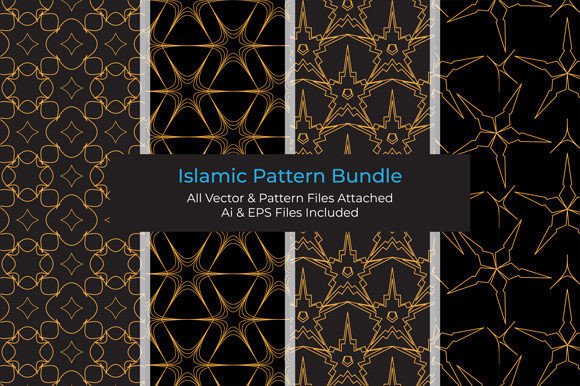
Arabic Islamic Seamless Pattern Set-4
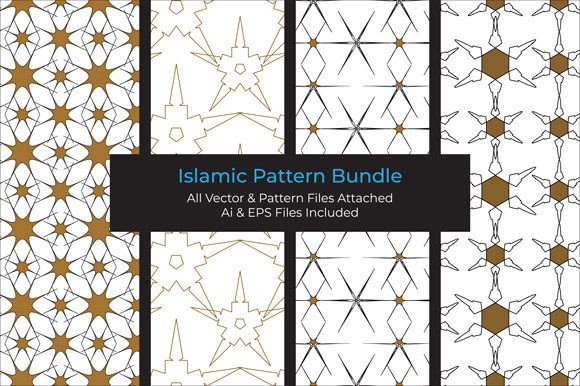
Arabic Islamic Seamless Pattern Set-4 is a curated digital collection of repeatable, tileable designs rooted in traditional Arabic and Islamic visual language. These patterns feature geometric interlacing, arabesque motifs, stylized floral elements, and calligraphic flourishes—crafted to align with historical design principles while meeting modern production requirements. The set includes 10 vector-based AI and EPS files (Adobe Illustrator version 10 compatible), along with high-resolution JPG versions at 300 dpi for immediate use in print and digital applications.
This collection is designed for creators who need culturally resonant, scalable, and technically reliable pattern assets—not decorative embellishments alone, but functional design components that maintain integrity across surfaces and scales. It assumes familiarity with basic graphic software workflows and does not include editable source layers or font files beyond embedded vector paths.
Who Might Consider Arabic Islamic Seamless Pattern Set-4?
Designers working on projects with clear cultural or thematic alignment—such as Arabic-language publications, mosque renovations, Islamic educational materials, or regional branding initiatives—may find this set practical. It is also relevant for wedding stationery designers serving communities where Arabic or broader Oriental aesthetics are meaningful, and for marketers preparing seasonal campaigns tied to Ramadan, Eid al-Fitr, or Eid al-Adha. Print service providers, textile designers exploring surface patterns, and educators developing visual resources about Islamic art may also evaluate it for technical consistency and stylistic authenticity.
Key Benefits
The primary benefit lies in its seamless tiling behavior: each pattern repeats without visible seams or alignment artifacts, reducing manual editing time when scaling across large-format prints or web backgrounds. The inclusion of both AI/EPS and JPG formats supports flexibility—vector files allow infinite resizing and color adjustments without quality loss; JPGs offer plug-and-play usability for users without vector-editing tools. At 300 dpi, the raster files meet standard print resolution thresholds for brochures, posters, and invitations.
Another advantage is stylistic cohesion: the 10 patterns share a consistent line weight, density, and motif vocabulary, making them suitable for multi-element layouts where visual harmony matters—such as a suite of wedding cards or a series of Ramadan social media graphics. Unlike generically “Middle Eastern” themed packs, this set avoids figurative or non-traditional elements, staying grounded in conventions recognized within classical Islamic design traditions.
Tradeoffs and Practical Considerations
Arabic Islamic Seamless Pattern Set-4 does not include color variants or alternate motif arrangements. Users seeking monochrome, gold foil, or pastel adaptations must adjust colors manually using vector editing software. Similarly, while the patterns are scalable, their complexity means very small-scale applications—like embroidery digitizing or micro-printing—may require simplification or testing to ensure legibility.
The set contains no licensing guidance beyond standard commercial use terms. Designers incorporating these patterns into client work should verify usage rights with the distributor, especially for products intended for resale (e.g., printed fabric by the yard or mass-produced greeting cards). Also, because the motifs draw from shared cultural heritage rather than proprietary invention, they do not confer unique brand identity on their own—complementary original illustration or typography remains essential for differentiation.
Compatibility is limited to Adobe Illustrator version 10 and later. Users relying exclusively on Affinity Designer, CorelDRAW, or older Illustrator versions may encounter import issues or missing features. The absence of SVG or PDF alternatives further narrows accessibility for web-first or open-source toolchains.
Situations Where This Set Is a Strong Fit
Arabic Islamic Seamless Pattern Set-4 works well when the project requires rapid deployment of authentic-looking background textures across multiple deliverables—such as designing a full Ramadan campaign (email headers, social banners, printable prayer schedules) or producing a set of bilingual wedding stationery (invitations, menus, table numbers). Its value increases when vector editing capability exists and when consistency across touchpoints outweighs the need for highly customized or experimental visuals.
It is also appropriate for institutional use where adherence to recognized Islamic design conventions matters—for example, creating interior signage for a community center or developing learning aids for an art history course focused on geometric abstraction in Islamic architecture.
When Alternatives May Be Worth Exploring
If your goal is to build a distinctive brand identity rather than support a culturally specific theme, a custom pattern commission may yield more strategic value. Likewise, if your workflow relies heavily on Figma, Canva, or web-based editors lacking native AI/EPS support, you may prefer pattern libraries offering SVG or CSS-compatible tiles.
For projects requiring adaptive color systems—such as dark-mode interfaces or accessible contrast compliance—pre-built JPGs limit flexibility compared to parametric or code-generated patterns. Similarly, if your output includes motion graphics or interactive elements, static seamless files will need additional processing for animation or responsive behavior.
Finally, if historical accuracy is critical—for instance, replicating Mamluk-era woodwork or Safavid tilework—this set offers stylistic approximation, not scholarly reconstruction. In those cases, consulting archival sources or collaborating with specialists in Islamic art history would be necessary alongside any pattern use.
Making a Practical Decision
Before choosing Arabic Islamic Seamless Pattern Set-4, clarify three things: your output format (print vs. screen, static vs. interactive), your editing environment (vector-capable software available?), and your definition of “authenticity” (stylistic resonance vs. period-specific fidelity). If your priority is efficiency, cultural appropriateness, and cross-platform compatibility within conventional design pipelines, this set delivers measurable utility.
If instead you need maximum adaptability across platforms, deep customization, or academic precision, allocate time to explore open-access museum collections (e.g., the Metropolitan Museum of Art’s Heilbrunn Timeline), licensed pattern services with broader format options, or direct collaboration with illustrators experienced in Islamic geometric design.
Ultimately, Arabic Islamic Seamless Pattern Set-4 functions best as a foundational resource—not a standalone solution. Its strength lies in supporting intentional, respectful design decisions, not replacing them. Evaluating it alongside your technical constraints, audience expectations, and creative goals ensures it serves its purpose without overpromising scope or significance.