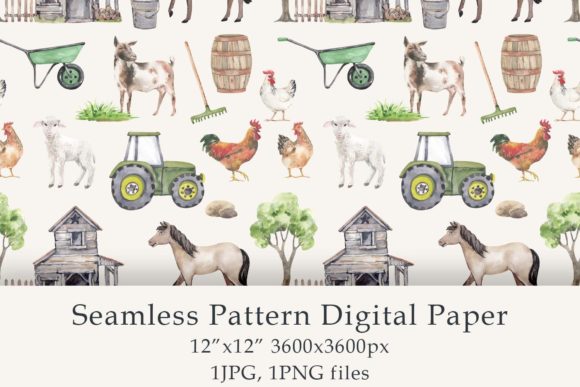
Watercolor Goat Farm Seamless Pattern
If you're designing for print-on-demand, crafting custom merchandise, or building a cohesive brand identity with rustic charm and artisanal warmth, the Watercolor Goat Farm Seamless Pattern is more than just decorative—it’s a versatile, ready-to-deploy creative asset. Hand-painted with intentional texture, soft edges, and natural tonal variation, this pattern captures the gentle personality of farm life without cliché or cartoonishness. It’s designed to feel authentic—not mass-produced—and built to scale beautifully across physical and digital surfaces.
What Makes This Pattern Stand Out
This isn’t a generic clipart repeat. Each goat, leaf, fence post, and wildflower was painted by hand using real watercolor pigments, then digitally refined to preserve grain, bleed, and subtle imperfections. The result? A seamless tile that flows naturally—no visible joins, no pixelated edges, no awkward repetition. At 300 dpi and 12×12 inches, both the JPG and PNG files retain crisp detail whether printed on a tote bag at 16×16 inches or scaled down for a phone case preview thumbnail.
The color palette leans into earthy, approachable tones: warm oat, dusty sage, faded denim blue, and creamy parchment—colors that sit comfortably alongside natural fibers, kraft paper packaging, or minimalist web interfaces. Importantly, it’s not overly saturated or contrast-heavy, so it pairs well with typography overlays, photo collages, or layered design elements without competing for attention.
Where This Pattern Adds Real Value
For small business owners launching a line of farm-themed stationery or organic skincare labels, the Watercolor Goat Farm Seamless Pattern offers immediate visual cohesion. Instead of commissioning custom illustrations (which can cost $300–$800+), you get a professional-grade, license-cleared asset in under a minute—ready for Canva, Adobe Illustrator, Procreate, or even Cricut Design Space.
Educators developing classroom resources about rural ecosystems or sustainable agriculture often struggle to find age-appropriate yet visually mature imagery. This pattern works equally well as a background for printable flashcards, lesson plan headers, or student project templates—its gentle aesthetic supports learning without infantilizing content.
Freelance designers building mood boards for clients in the wellness, homesteading, or slow-living niches use patterns like this to signal tone before a single word is written. It communicates care, authenticity, and tactile quality—qualities increasingly valued in an oversaturated digital marketplace.
Practical Uses You Might Not Expect
- Web & UI backgrounds: Tiled subtly behind blog sidebars or newsletter signup forms adds warmth without sacrificing readability.
- Packaging mockups: Apply it directly to flat lay templates for Etsy or Shopify product previews—no need to fake “handmade” texture with filters.
- Custom fabric printing: Works reliably with Spoonflower, Contrado, or local print shops because of its high-resolution, CMYK-friendly color range.
- Classroom displays: Print full-sheet on matte cardstock, trim into borders, and use around bulletin boards for seasonal themes (spring lambing, autumn harvest).
- Branded Zoom backgrounds: Scale down slightly and overlay with a semi-transparent logo—ideal for virtual farm tours or agritourism marketing calls.
How to Use It Without Compromising Quality
Start by opening the PNG file in your preferred editor. Its transparent background gives you flexibility—you can drop it over solid colors, gradients, or photos without white halos or edge fringing. For large-format printing (like banners or wall decals), duplicate and offset the tile manually in Illustrator or Affinity Designer to ensure perfect alignment at scale—don’t rely solely on auto-tiling tools, which sometimes introduce micro-gaps.
If you’re layering text or icons over the pattern, test legibility at multiple sizes. Because watercolor textures vary in density, some areas may be lighter or busier than others. A quick opacity adjustment (85–92%) often improves contrast while preserving depth. Avoid heavy drop shadows or outer glows—they flatten the organic feel.
For commercial resale (e.g., selling mugs or t-shirts), confirm your license permits derivative use. This particular Watercolor Goat Farm Seamless Pattern includes standard extended commercial rights—meaning you can apply it to unlimited physical products, provided you don’t resell the pattern file itself or claim authorship of the original artwork.
Things to Consider Before You Download
While highly adaptable, this pattern isn’t ideal for every context. If your brand relies on stark modernism, neon accents, or ultra-minimalist geometry, it may clash rather than complement. Likewise, if you need tight control over individual elements (e.g., moving one goat independently), a seamless pattern won’t offer vector-level editing—opt for a separate illustration pack instead.
Also note: because it’s hand-painted, no two tiles are *identical* in pigment distribution—even within the same file. That’s a feature, not a flaw. It mimics how real watercolor behaves on paper, adding quiet visual interest. But if your workflow demands absolute pixel-perfect uniformity (e.g., for technical textile repeats), test a small section first.
Why It Fits Into Thoughtful Creative Workflows
In a landscape flooded with AI-generated “cute animal” assets, the Watercolor Goat Farm Seamless Pattern stands out by prioritizing craft over convenience. It doesn’t try to be everything—it’s intentionally pastoral, gently imperfect, and quietly expressive. That specificity makes it memorable. When customers see it on a coffee sleeve or journal cover, they register intentionality: someone chose this, not just scrolled past ten options.
That sense of care translates directly into perceived value. A handmade soap label backed by this pattern reads differently than one using stock vector goats—it suggests connection, story, and stewardship. And for creators juggling tight deadlines and limited budgets, that emotional resonance comes without extra time investment.
Whether you’re prototyping a new product line, refreshing a website’s visual language, or preparing materials for a community workshop, this pattern delivers consistent performance across formats. It’s not flashy—but it’s reliable, respectful of its subject matter, and built to support human-centered design decisions, not replace them.