Seamless Pattern Valentine’s Day
If you’re designing something for Valentine’s Day—whether it’s a hand-lettered greeting card for your niece, a limited-edition planner cover for your Etsy shop, or branded social media graphics for a local café—you need patterns that feel intentional, not generic. That’s where Seamless Pattern Valentine’s Day stands out: 20 thoughtfully crafted, high-resolution digital papers designed to tile perfectly without visible seams or awkward repeats. No cropping, no guessing, no pixelated edges when printed—just clean, consistent, ready-to-use visuals that support your vision, not distract from it.
Why “Seamless” Actually Matters in Real Projects
A seamless pattern isn’t just a design buzzword—it solves real problems. Imagine printing a 12″ x 12″ scrapbook background on letter-sized paper: with a non-seamless file, you’d see obvious breaks or misaligned edges every time the pattern repeats. But these 20 designs are built to repeat infinitely in any direction. That means whether you’re scaling one up to cover an entire journal cover or shrinking it down for nail wrap templates, the rhythm stays smooth and cohesive. It’s the difference between a polished, professional finish and something that looks hastily assembled.
Where These Patterns Fit Into Everyday Creative Work
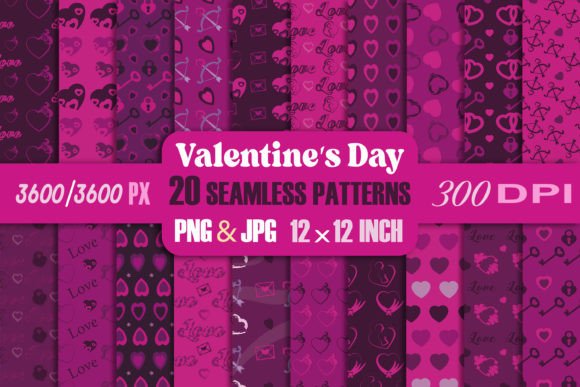
These aren’t just “cute hearts and roses.” Each of the 20 designs balances theme and versatility—think subtle watercolor blush textures, modern minimalist line art hearts, retro-inspired halftone dots, delicate lace overlays, and even playful typographic repeats with phrases like “forever” or “you & me.” That variety matters because your needs shift depending on context:
- Small business owners use them for printable gift tags, custom sticker sheets for product packaging, or limited-run T-shirt prints—especially helpful if you’re launching a Valentine’s-themed collection but don’t have in-house design resources.
- Educators and homeschoolers drop them into editable Canva worksheets, classroom bulletin board backdrops, or student-made valentines that feel special—not clipart-generic.
- Freelance designers and marketers layer them behind text in email headers, adapt them for Instagram Story templates, or export sections as SVG-ready assets for web backgrounds (yes—they scale cleanly).
- Hobbyists and crafters print them directly onto iron-on transfer paper for fabric projects, cut them into bottle cap charms, or use them as base layers for resin jewelry molds—no distortion, even at tiny sizes.
What You’ll Actually Receive—and Why File Type & Resolution Matter
You’ll get one ZIP file containing 20 JPEGs and 20 PNGs—all at 300 DPI and sized 12″ x 12″ (3600 x 3600 pixels). That resolution isn’t overkill; it’s practical. At 300 DPI, you can confidently print full-size planner covers on matte cardstock, produce crisp 5×7″ invitations on premium paper, or resize sections for smartphone lock screens without blurriness. The dual format gives flexibility: JPEGs for quick web use or mockups, PNGs when you need transparent backgrounds—for layering over photos in Lightroom or placing logos cleanly on tote bag mockups.
Real Situations Where These Patterns Save Time (and Stress)
Think about last-minute requests: your friend asks you to help design her wedding’s Valentine’s Day brunch menu—three days before the event. With these patterns, you open one file, drop it into InDesign as a background, overlay elegant typography, and export a print-ready PDF in under an hour. Or imagine running a small stationery shop and needing fresh inventory before February 1st. Instead of commissioning custom illustrations each season, you mix and match these patterns with your existing fonts and color palettes to create new cards, stickers, and digital downloads—fast, consistently on-brand, and cost-effective.
Even educators benefit quietly: a middle school art teacher used one of the geometric heart patterns to teach symmetry and repetition in digital design class. Students imported the files into free tools like Photopea, experimented with cropping and tiling, then created their own variations—no subscription needed, no copyright concerns.
Things to Consider Before Using Them
While these patterns are flexible, they work best when matched intentionally to your project’s tone and audience. A vintage script heart pattern might feel perfect for a handmade soap label but too ornate for a tech startup’s internal Valentine’s Day Slack banner. Likewise, check your output method: if you’re laser-printing on kraft paper, lighter-colored patterns often reproduce more clearly than deep reds or blacks. And remember—these are digital papers, not editable vector files. You can adjust brightness, contrast, or hue in Photoshop or GIMP, but you can’t ungroup or recolor individual elements within the pattern itself.
More Than Just “Valentine’s Day”—A Tool for Year-Round Creativity
Don’t limit these to February. Several designs—like the soft dot grid, muted floral repeat, or abstract heart silhouette—translate easily into spring themes, anniversary projects, or even gender-neutral love celebrations. One customer repurposed the chalk-textured heart pattern as a background for a baby shower invitation (“love grows here”), simply by changing the font and swapping pink accents for sage green. Another used the minimalist line-art version to design a reusable shopping bag for a local bookstore’s “Love Local” campaign—proof that thoughtful pattern design has legs far beyond a single holiday.
Whether you're building a portfolio, launching a side hustle, planning a family celebration, or just want to make everyday items feel more personal, Seamless Pattern Valentine’s Day delivers consistency, quality, and quiet confidence—the kind that comes from knowing your background won’t betray you at print time.