Seamless Skulls: Strategic Design Assets for Purpose-Driven Creatives
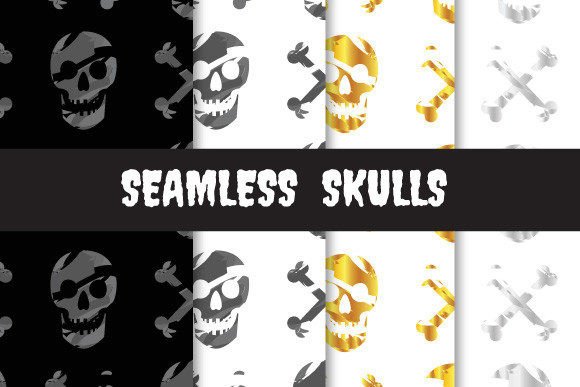
Seamless Skulls isn’t just a collection of repeating vector patterns—it’s a precision-crafted design resource built for intentionality. Each pattern repeats flawlessly across any surface, with no visible seams or breaks, at full professional resolution: 12 × 12 inches (3600 × 3600 pixels), 300 dpi. Delivered as four EPS 10 files and four high-fidelity JPEGs in a single ZIP package, it bridges creative flexibility with production readiness. That technical consistency matters—not as a feature to admire, but as infrastructure for decisions that scale.
Why Seamless Skulls Fits Real Workflows—Not Just Aesthetic Moments
Skull motifs carry layered meaning: mortality, transformation, rebellion, focus, legacy. But meaning alone doesn’t drive value. What does is how consistently and cleanly that meaning integrates into your output. Seamless Skulls removes the friction of tiling, scaling, or troubleshooting alignment—common bottlenecks when adapting symbolic imagery across packaging, apparel, web backgrounds, presentation decks, or print collateral. For entrepreneurs launching limited-edition merchandise, for educators designing thematic course materials, or for publishers developing editorial visual systems, this consistency preserves message integrity without demanding extra time or technical overhead.
Consider a small-batch apparel brand introducing a “Clarity Collection” centered on focused action and intentional living. Using Seamless Skulls allows them to apply the same motif across fabric prints, hang tags, and social media banners—without distortion, pixelation, or manual repetition. The result isn’t just visual cohesion; it’s reinforced positioning. Every touchpoint quietly reinforces the same conceptual anchor: awareness, discipline, evolution.
Strategic Use Starts With Alignment—Not Aesthetics Alone
Before opening the ZIP file, ask: What outcome do I need this to support? Seamless Skulls gains strategic weight only when matched to a clear objective—brand identity refinement, audience resonance, operational efficiency, or experiential continuity. Without that grounding, even technically perfect assets risk becoming decorative noise.
- For branding: Use one pattern as a subtle background texture in email headers or slide templates—not as a dominant logo replacement, but as a tonal undercurrent that signals consistency across channels.
- For product development: Apply Seamless Skulls to mockups early in the design phase. Seeing how the pattern behaves on curved surfaces, woven textiles, or embossed paper helps anticipate real-world constraints before production begins.
- For content creation: Embed a scaled-down version into blog post dividers or newsletter footers—not to shout, but to create rhythm and recognition over time.
This isn’t about using every file. It’s about selecting the one pattern whose line weight, density, and negative space best serve your current priority—then using it deliberately, repeatedly, and contextually.
Technical Precision Enables Creative Confidence
The EPS 10 format ensures full editability in Adobe Illustrator and compatible vector environments. You can recolor, resize infinitely, isolate elements, or combine with other vectors—all without quality loss. That’s not convenience; it’s control. When you’re iterating on a client presentation or adjusting a label design for regulatory compliance, that editability reduces revision cycles and eliminates last-minute raster fallbacks.
The JPEG counterparts aren’t afterthoughts. They’re production-ready for platforms that don’t accept EPS—think CMS editors, social media schedulers, or email builders where vector upload isn’t supported. Having both formats means you’re never choosing between fidelity and functionality. You’re choosing the right tool for the environment—and doing so without re-exporting, resampling, or second-guessing resolution.
When Seamless Skulls Adds Value—and When It Doesn’t
It adds value when used as part of a documented visual strategy—not as a “cool thing to drop in.” It supports long-term brand equity when applied with restraint and repetition across at least three distinct applications over six months. It improves customer experience when it contributes to environmental storytelling—say, reinforcing a wellness clinic’s theme of mindful transition through subtle wall graphics.
It loses strategic relevance when deployed without context: slapping a skull pattern onto a financial services report, applying it across unrelated product lines without narrative linkage, or using it purely for shock value without aligning with audience expectations or organizational values. In those cases, the seamlessness becomes ironic—the pattern flows perfectly, but the meaning doesn’t.
Ask yourself: Does this reinforce what my audience already understands about me—or does it introduce dissonance? Is this supporting an existing initiative, or distracting from one? Seamless Skulls amplifies clarity—but only if clarity already exists in your intent.
Practical Integration: Four Planning Principles
Integrating Seamless Skulls effectively isn’t about speed—it’s about sequencing. Here’s how experienced creatives and operators approach it:
- Map before you place. Sketch where the pattern will appear in your ecosystem—physical, digital, and experiential. Note scale, lighting, material, and viewing distance. A pattern that reads powerfully on a tote bag may vanish on a mobile screen.
- Test contrast and legibility first. Overlay sample text or icons on the JPEG versions. Does critical information remain readable? If not, adjust opacity, add a subtle overlay, or choose a lower-density pattern variant.
- Document usage rules—not just permissions. Specify which pattern goes where, at what scale, and with what color restrictions. This prevents drift across teams and maintains coherence as projects scale.
- Review quarterly—not just once. Revisit how the pattern is functioning in live contexts. Are customers referencing it unprompted? Is it appearing in unexpected places (e.g., user-generated content)? That feedback informs whether to deepen, simplify, or retire its use.
Risk Awareness: The Cost of Unintentional Repetition
Repetition is powerful—but unexamined repetition is costly. Using Seamless Skulls without clarifying goals can dilute messaging, confuse audiences, or unintentionally signal inconsistency (e.g., applying different skull patterns across a single campaign). Worse, overuse in low-context environments—like generic stock-style website headers—can flatten meaning into cliché.
The real risk isn’t technical failure. It’s strategic misalignment: investing time in implementation while neglecting the “why” behind each placement. That gap shows up in metrics—lower engagement on branded assets, inconsistent recall in customer interviews, or higher revision requests from stakeholders who sense something “off” but can’t name it.
Long-Term Value Lies in Discipline, Not Volume
Seamless Skulls delivers diminishing returns the more broadly and loosely it’s applied. Its highest ROI emerges from sustained, selective use—not scattered deployment. One well-placed pattern in a physical retail space, repeated across digital signage and staff uniforms over 18 months, builds associative strength far beyond any single application.
That kind of impact requires patience. It asks you to treat the asset not as a shortcut, but as a commitment—to consistency, to audience understanding, and to the slow work of building recognition through repetition with purpose.
So open the ZIP. Study the four EPS files—not for variety, but for nuance. Compare line weights. Notice how negative space shifts emphasis. Then choose one. Apply it where it supports—not substitutes for—your existing strategy. Let it repeat seamlessly. Let your intent do the rest.